
Top

Visit Bagno Vignoni

The village that floats on the thermal waters of the Val d’Orcia

In the heart of the Val d’Orcia, Bagno Vignoni is a small Tuscan village unique in the world: its main square is a large pool of steaming thermal water. It is an ideal destination for RV enthusiasts looking for relaxation, breathtaking landscapes, and authentic flavors.
Surrounded by hills, cypresses, and medieval villages, Bagno Vignoni offers an experience that combines wellness, history, and nature.

Stopovers and overnight stays

Bagno Vignoni is easily reachable by camper, even if the village is compact and the roads can be narrow. The most convenient stop is just outside the center.

Recommended areas

Municipal Parking Area
Str. di Bagno Vignoni, 1, 53027 San Quirico d’Orcia SI
Area reserved for campers at the end of the road. In October 2025, road resurfacing work was in progress and the area was not accessible.
GPS: 43.029572, 11.624931
🅿️ Free space on dirt road
Str. di Bagno Vignoni, 1, 53027 San Quirico d’Orcia SI
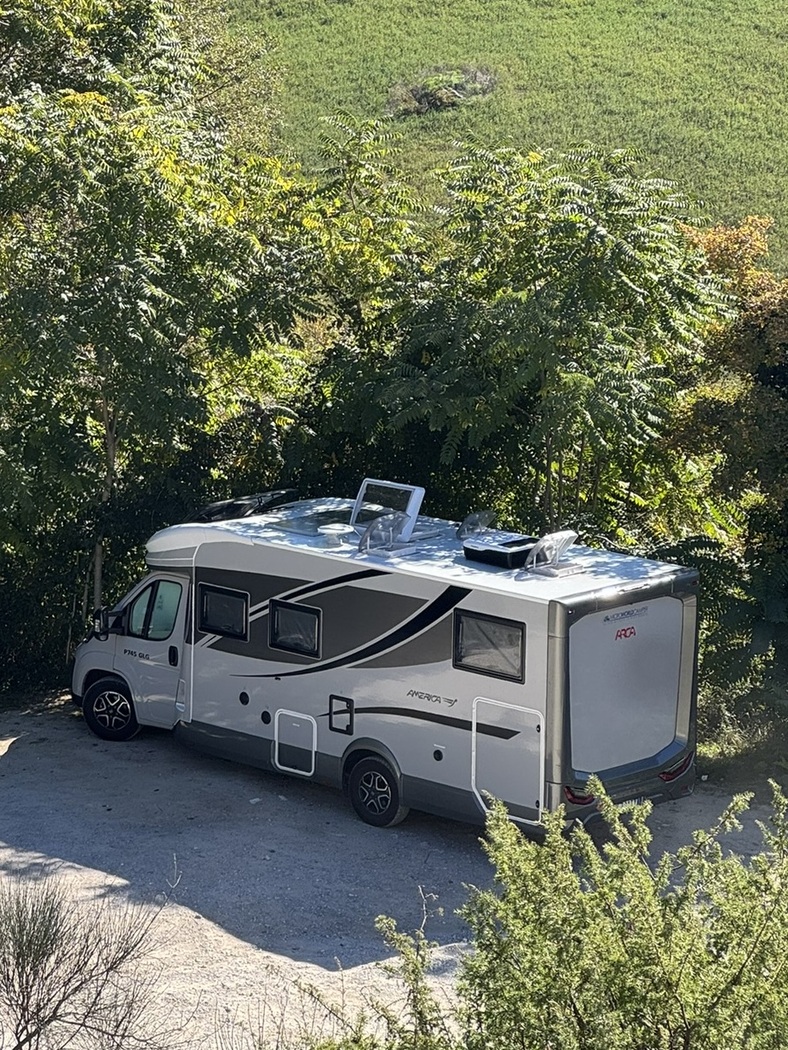
On the left, 100 meters before the junction for the parking lot described above, there is a turn-off onto a dirt road that leads to the ancient free Roman baths. Along the road, there are spaces where it is possible to park the camper without obstructing the passage of other vehicles.
GPS: 43.027972, 11.622748

RV Parking Area – San Quirico d’Orcia, Via delle Scuole, 1, 53027 San Quirico d’Orcia SI
2.5 km from Bagno Vignoni, on a paved, flat area in front of a beautiful park with picnic tables for outdoor dining and games for children. Paid parking, equipped with water loading and unloading services.
GPS: 43.056053, 11.606717

Getting Around

The village of Bagno Vignoni is small and pedestrianized: it is easy to explore on foot. To explore the surroundings, one can:
     
  • Use a bike or e-bike to reach San Quirico d’Orcia and the views towards Castiglione d’Orcia.
  •  
  • Take advantage of the SR2 scenic road (Cassia) for day trips towards Pienza, Montepulciano, or Montalcino.
  •  
  • In summer, some thermal hotels offer shuttles for short trips.
To explore the surroundings:
Bicycle or e-bike: excellent means of transport to reach Monticchiello (4 km) or San Quirico d’Orcia (10 km).
Tiemme local buses: connect Pienza to Montepulciano and Montalcino (line 112A).

“…stop on the unpaved road”

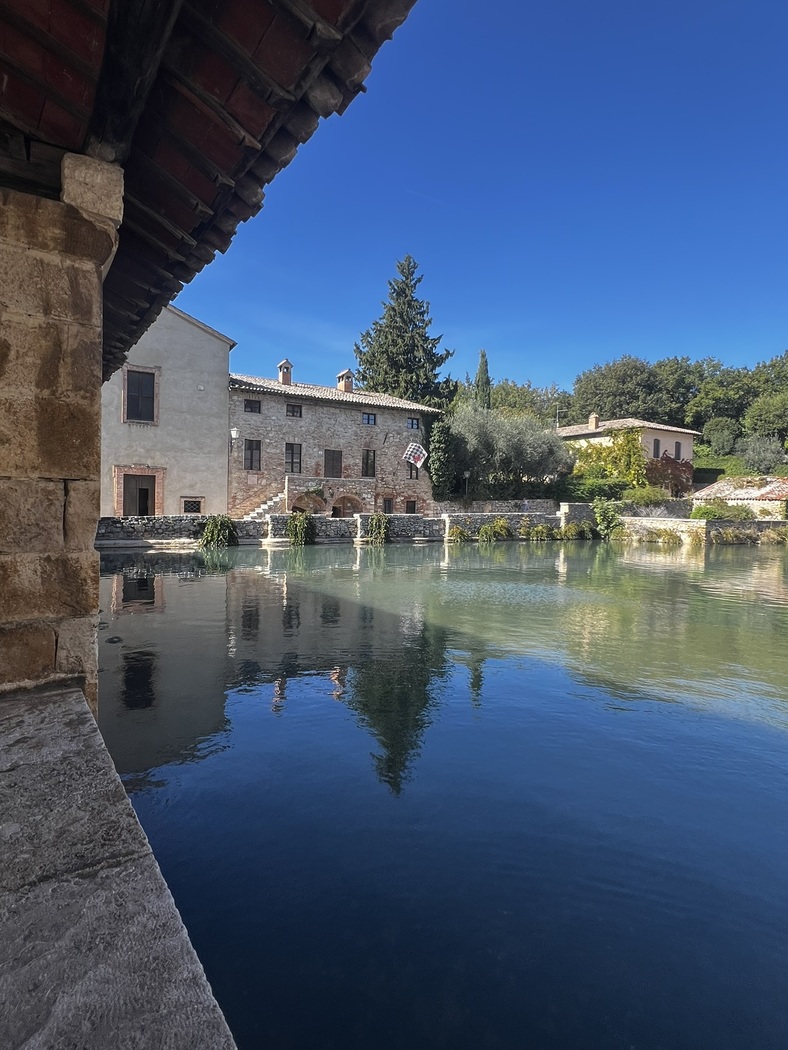
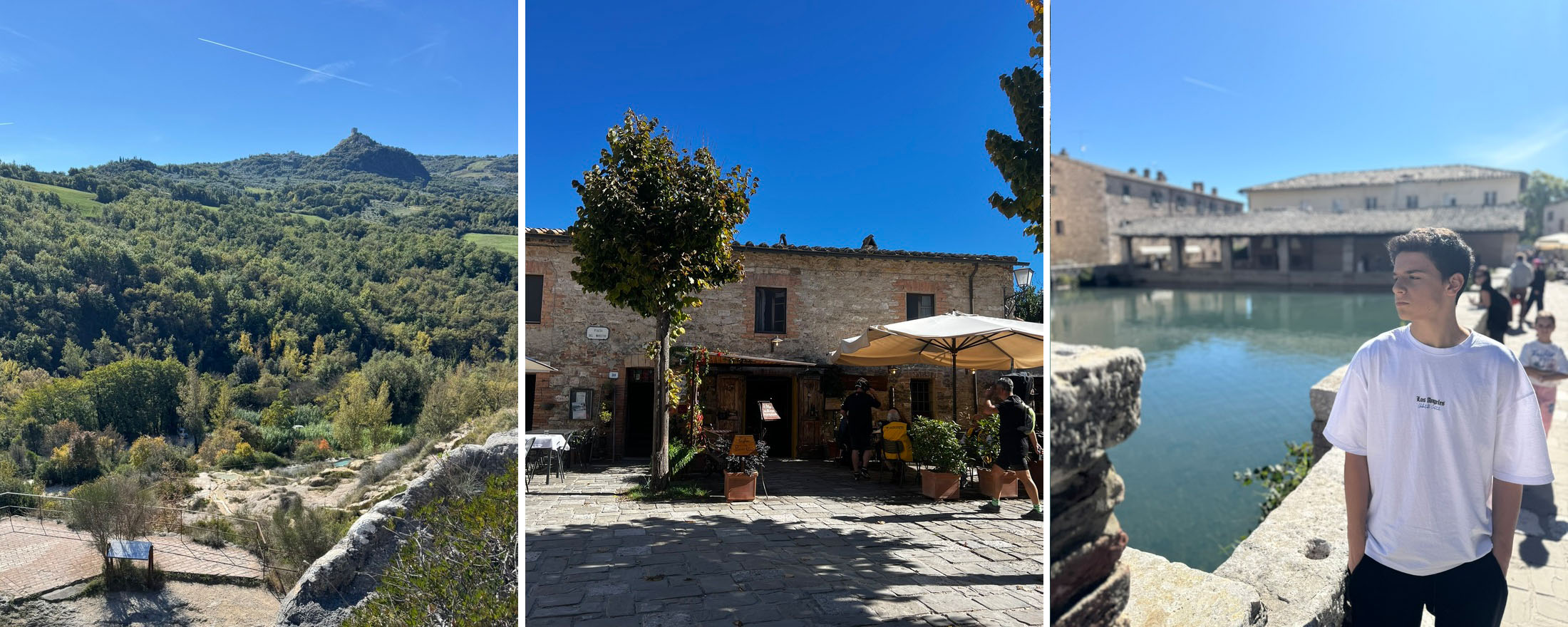
view of the thermal pool

Points of Interest (PoI)

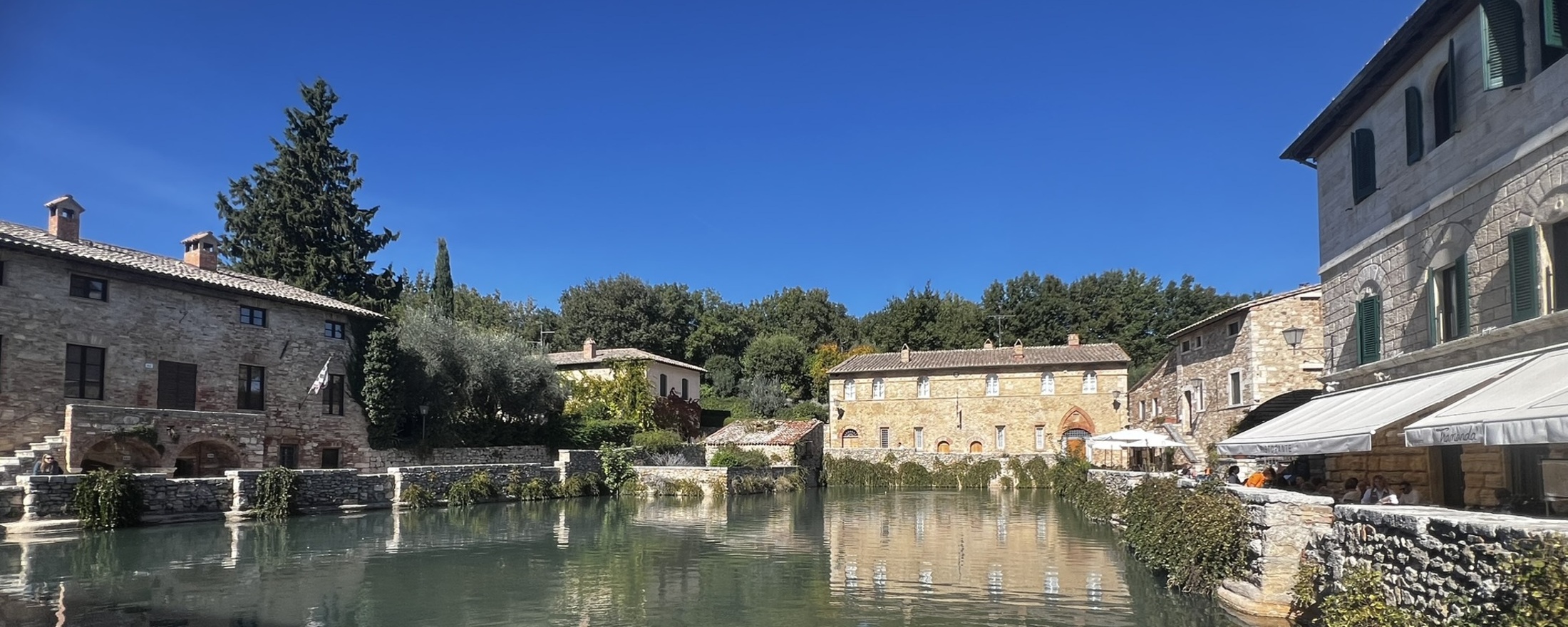
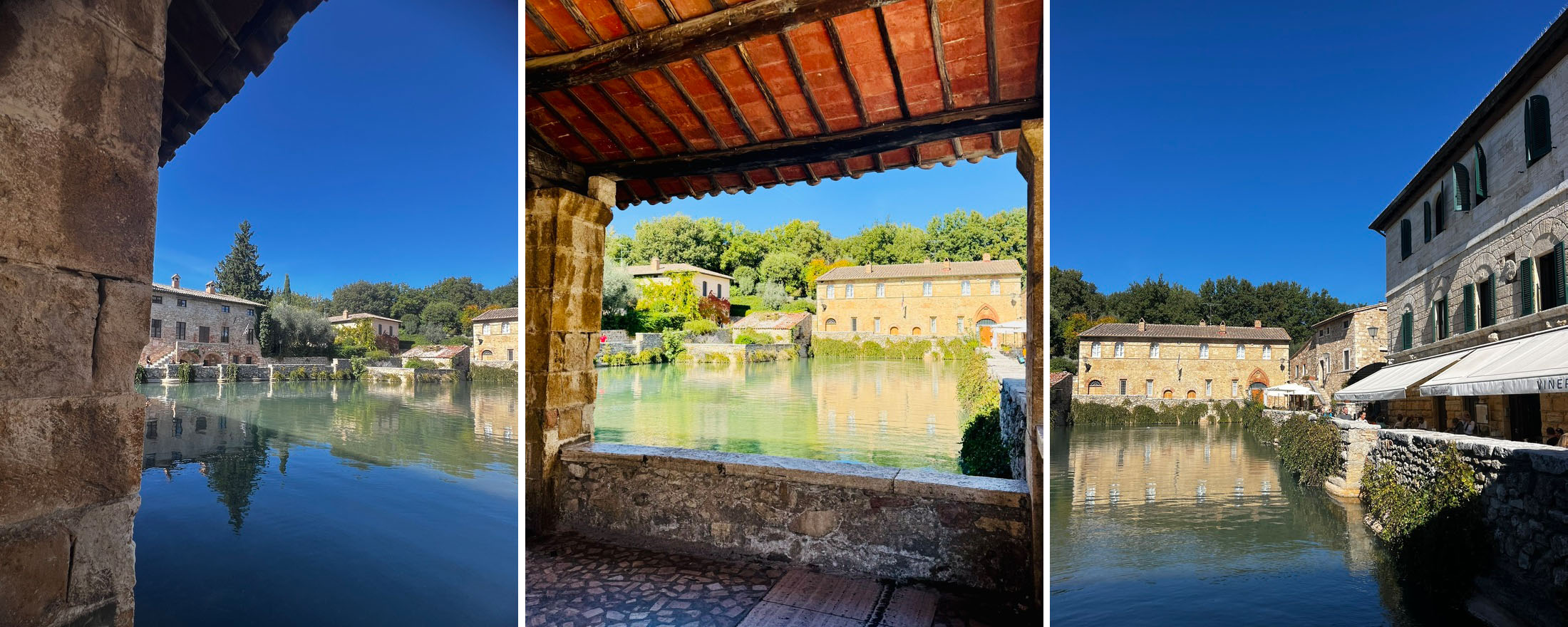
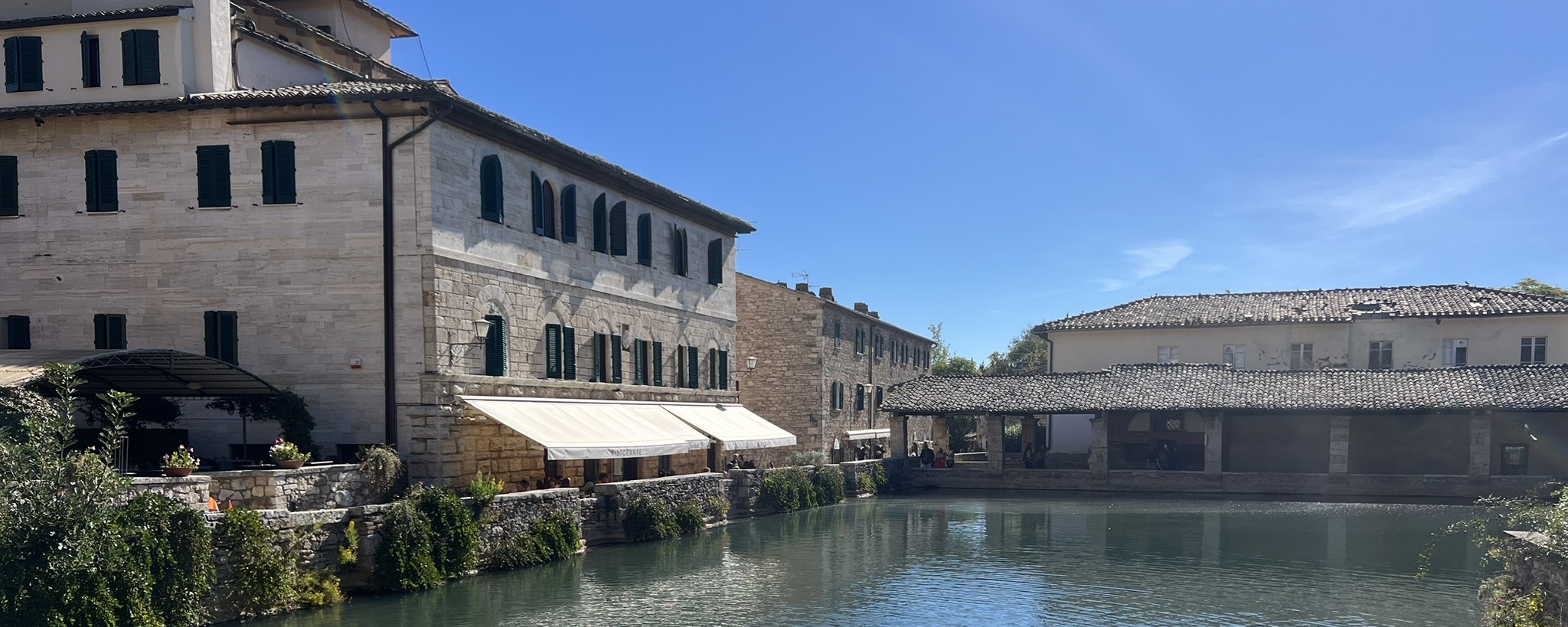
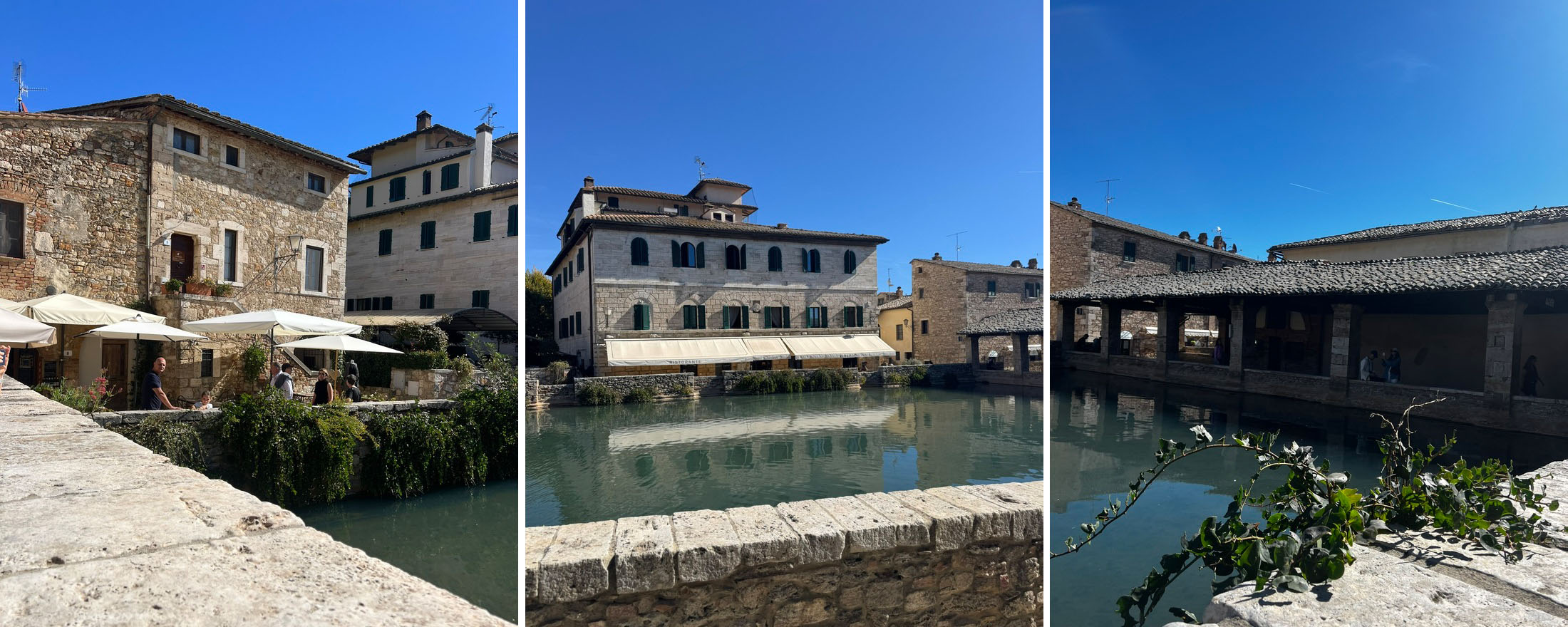
The village is unique because its historic center develops around its main square, which is actually a large thermal pool.
1
Piazza delle Sorgenti The Piazza delle Sorgenti (Square of the Springs) is the pulsating heart of Bagno Vignoni and is a square unique in the world. It is not a traditional piazza, but rather a large rectangular pool from the sixteenth century that collects the thermal water gushing from the underground aquifer. The water, rich in mineral salts, is hot and steaming, especially in the evening or colder hours, creating an evocative and timeless atmosphere. Historical palaces, inns, and the Loggia of Santa Caterina da Siena, who used to retreat here for prayer, overlook the pool. Important: Swimming in the square's pool is not permitted.
2
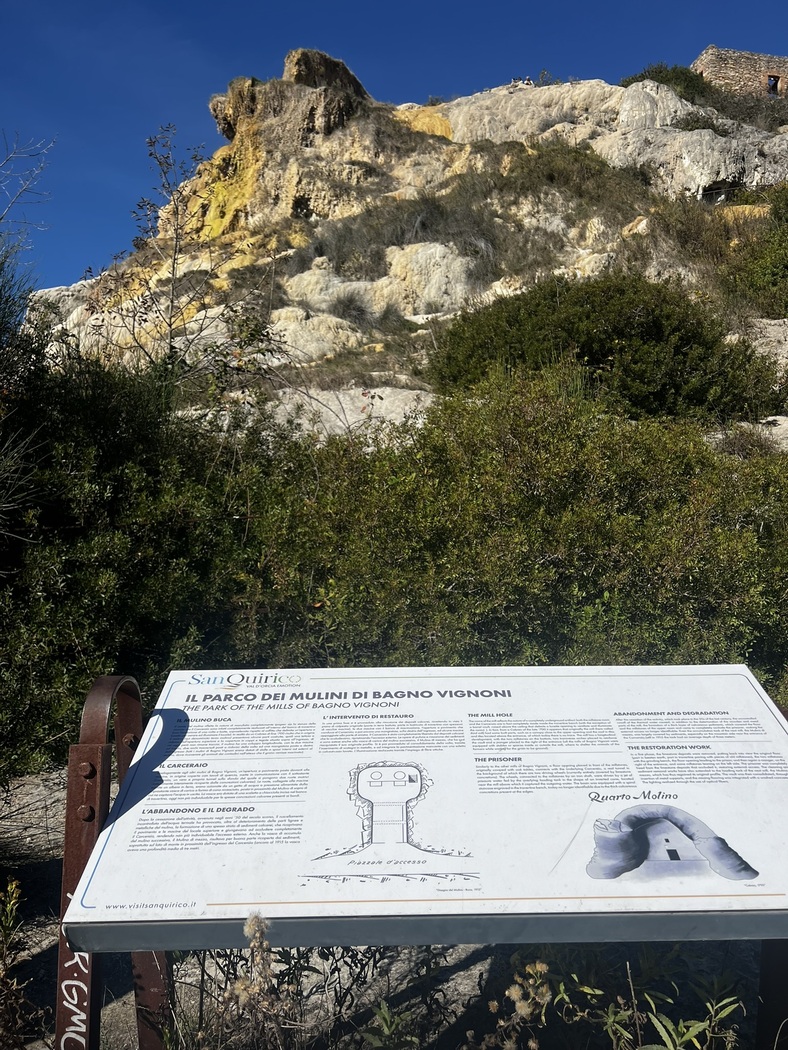
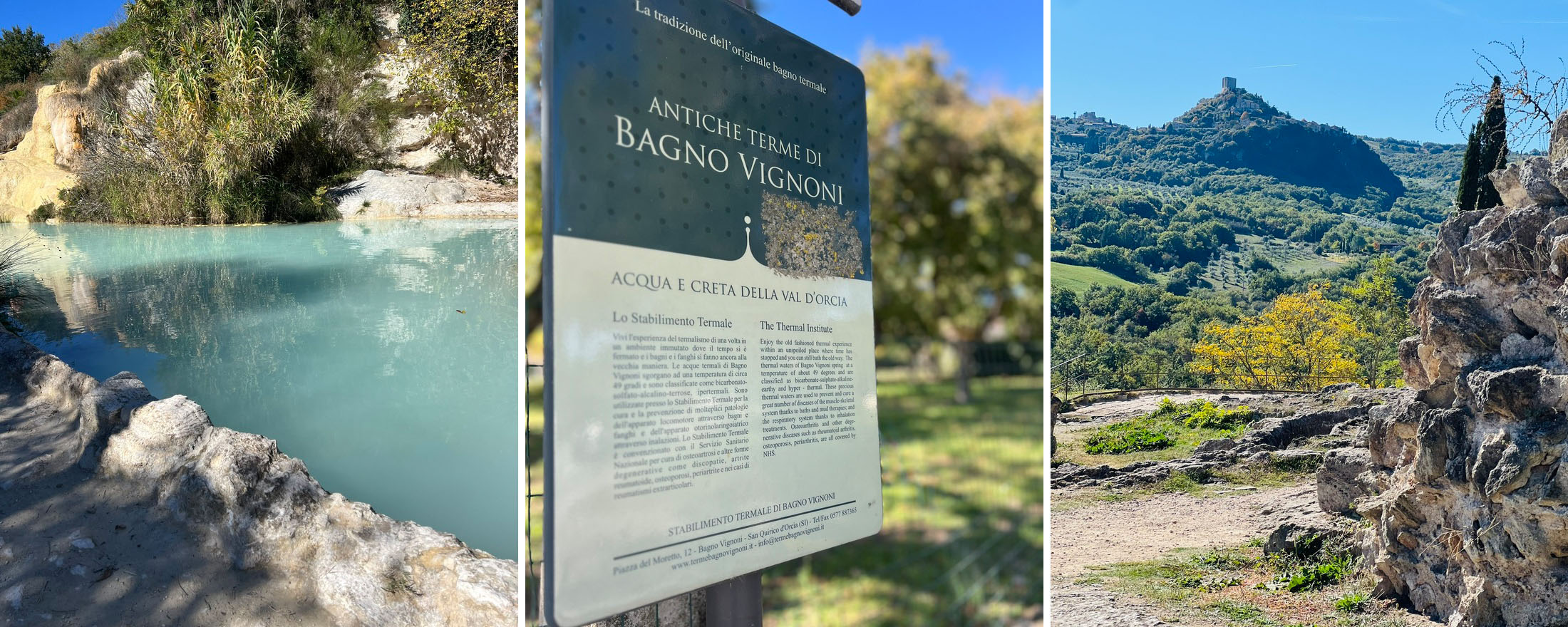
Parco dei Mulini The Parco Naturale dei Mulini (Natural Park of the Mills) is a protected natural area located a short distance from the center of the village, where the thermal waters from the Piazza delle Sorgenti flow out. Historically, the Park was an important milling center, powered precisely by the thermal water which, thanks to its perennial flow, guaranteed the activity of the four hypogeal (underground) mills, the remains of which can be admired today. These mills are a testament to human ingenuity in harmonizing activities with natural resources. The thermal water forms small waterfalls and streams (called gorelli) that cross the park, offering a landscape of great charm and an opportunity for walks.
3
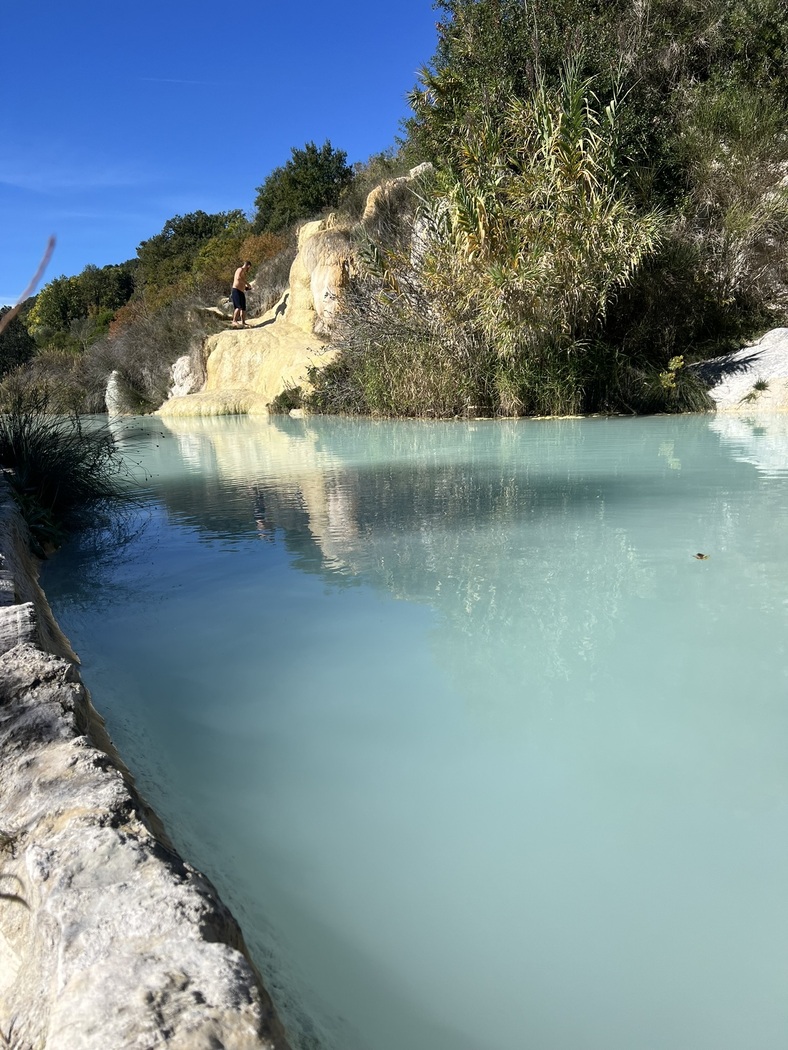
Vasche libere del fiume Orcia The free thermal pools of Bagno Vignoni are located in the lower part of the Parco dei Mulini and are the place where the thermal water, after passing through the main square and the Park, collects and cools slightly before flowing into the Orcia river. These pools were once freely accessible for bathing, but due to a municipal ordinance, the largest thermal pool has been prohibited (in some periods, it is closed with a net). However, the streams and small puddles formed by the water descending along the escarpment are often used for foot baths and to enjoy the thermal benefits in a natural way.
4
Castiglione d’Orcia Castiglione d'Orcia is an evocative medieval village perched on a hill in the heart of the Val d'Orcia, a short distance from Bagno Vignoni. It is part of the UNESCO World Heritage Site. The village has millenary origins and was shaped by ancient noble families such as the Aldobrandeschi and the Salimbeni. Among its main symbols is the imposing Rocca Aldobrandesca (Aldobrandesca Fortress, which can be visited today), which dominates the valley and offers a spectacular view of the surrounding landscape. The historic center is characterized by small squares like Piazza Vecchietta (dedicated to the Sienese artist Lorenzo di Pietro), with a 16th-century travertine well at its center. The municipality of Castiglione d'Orcia also includes other medieval hamlets such as Rocca d'Orcia and Campiglia d'Orcia, as well as the thermal locality of Bagni San Filippo.
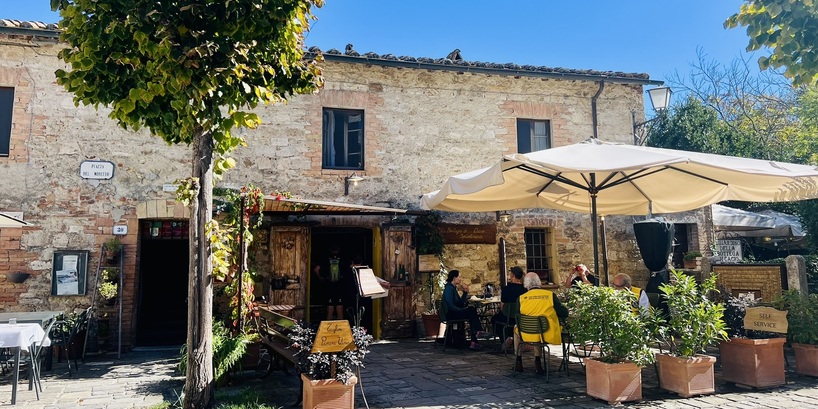
Mangiare a Bagno Vignoni

Seasonal Events

Thermal Water Festival
Where: Bagno Vignoni
When: July
What: historical re-enactments and shows around the Bagno Vignoni pool.
Pienza Pecorino Festival
Where: Pienza (15Km)
When: September
What: excellent opportunity to taste cheeses and typical products.
Christmas Markets in San Quirico d’Orcia
Where: San Quirico d’Orcia
When: December
What: the village lights up with stalls and local scents.

“Park of the Mills”

“water not very hot, but pleasant in mid-seasons”

Typical Dishes and Local Products

You can’t say you’ve truly experienced Val d’Orcia without tasting Cantucci, the iconic almond biscuits that represent the soul of Tuscan pastry-making. Born in Prato during the Middle Ages, these crunchy twice-baked biscuits are perfect to prepare in your camper and enjoy dipped in a glass of Vin Santo while watching the sunset over the Sienese hills.

Recipe for Tuscan Cantucci

Ingredients (for about 30 biscuits):
  • 300g all-purpose flour (type 00)
  • 200g whole almonds (unpeeled)
  • 180g sugar
  • 3 eggs (2 whole + 1 yolk for brushing)
  • 30g softened butter
  • 1 sachet baking powder (or 8g baking ammonia)
  • Grated zest of 1 orange
  • 1 pinch of salt
Preparation method:
  1. Preparing the dough: In a bowl, lightly beat 2 eggs with the sugar. Add the softened butter and grated orange zest. Mix until you obtain a smooth mixture.
  2. Incorporating the dry ingredients: Sift the flour with the baking powder and a pinch of salt. Add to the egg mixture and work with your hands until you form a compact dough.
  3. Adding the almonds: Incorporate the whole almonds into the dough, distributing them evenly. The dough will be quite firm and rich with almonds.
  4. Forming the logs: Divide the dough into two parts and form two logs about 25-30 cm long and 4-5 cm wide. Place them on a baking tray lined with parchment paper, well spaced apart.
  5. First baking: Brush the logs with the beaten egg yolk (you can dilute it with a little water). Bake in a preheated oven at 180°C for 20-25 minutes, until golden.
  6. Cutting and second baking: Remove from oven and let cool for 5 minutes. With a serrated knife, cut the still-warm logs diagonally into slices about 1.5 cm thick. Return the biscuits to the oven at 160°C for another 10-15 minutes, turning them halfway through cooking to achieve the characteristic even golden colour.
  7. Cooling: Let cool completely on a wire rack. The cantucci will be crunchy and crumbly, perfect for dunking.
Historical and cultural note
The name “cantuccio” derives from the word “canto,” which indicated the scraps of sweet loaves prepared by Prato bakers for noble families: what remained was cut into pieces (“cantucci”) and sold to peasant families. The oldest documented recipe dates back to an 18th-century manuscript by Amadio Baldanzi, a scholar from Prato, but it was Antonio Mattei, a 19th-century pastry chef from Prato, who perfected the recipe we know today. The characteristic double baking gives cantucci that unique crunchiness that makes them perfect for dunking in Vin Santo, creating a sensory experience that spans centuries. Today, Cantucci di Prato are recognized as an IGP product and represent one of the symbols of Tuscan pastry-making worldwide.

Useful Tips

Bagno Vignoni is an unmissable stop for those traveling by camper in the Val d’Orcia: it offers relaxation, culture, and postcard-perfect landscapes in a compact and easily visitable area. Recommended for a wellness weekend or as a stop on a wider itinerary between Pienza, Montalcino, and Montepulciano.

👉 Scopri altri itinerari e coordinate GPS su map.camperepoi.it (a breve!)

👉 Iscriviti alla newsletter di CamperePoi per scaricare la guida completa “Val d’Orcia in Camper”

0

post a comment